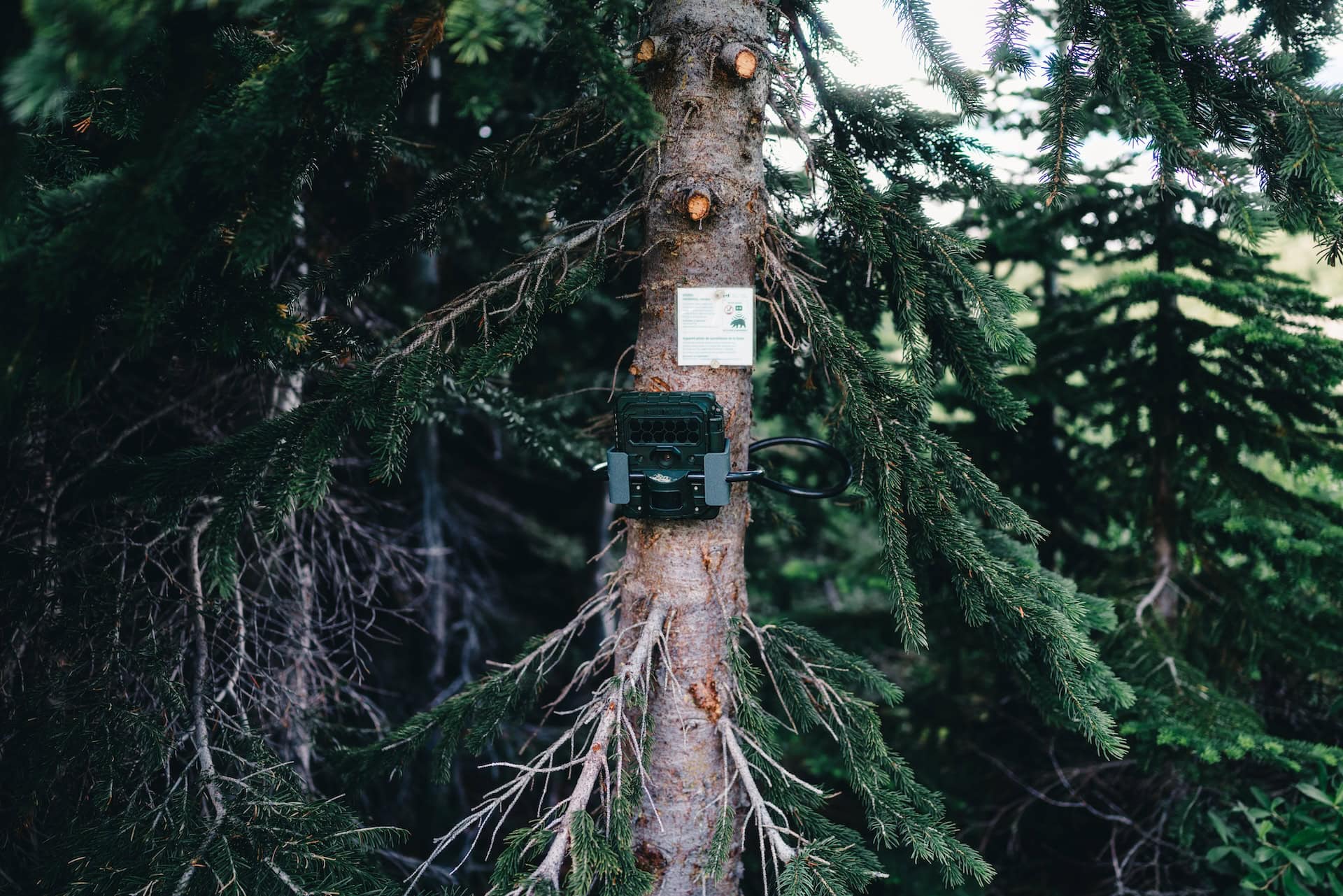
Camera traps are an important and widely used tool for monitoring large carnivores and golden jackals, providing valuable information on species occurrence, distribution, activity patterns, habitat use, individual identification, and interactions with humans and other wildlife. Their relatively low level of disturbance and ability to operate continuously make them particularly useful in the diverse landscapes of the Adriatic-Ionian Region, including protected areas, managed forests, agricultural landscapes, and areas with intensive human activity.
However, camera trapping can also create unintended risks for wildlife, people, and the quality of monitoring data. Camera traps should therefore be deployed and operated according to principles that minimise disturbance, respect privacy, protect sensitive information, and comply with relevant legal and ethical requirements.
Camera placement should avoid unnecessary disturbance to animals, particularly at dens, breeding sites, resting sites, carcasses, feeding locations, and other sensitive areas. Field visits for installation and maintenance should be kept to the minimum necessary. The use of bait, food, scent lures, or other attractants should not be routine and, where used for a justified scientific purpose, should be carefully considered, documented, and consistent with applicable legislation and ethical standards.
Because cameras may unintentionally record people, particularly in areas accessible to the public, their placement and operation should minimise unnecessary recording of individuals. Images containing identifiable people should be handled in accordance with applicable privacy and data-protection requirements.
Camera-trap images and associated location information should also be protected against unauthorised access and inappropriate public disclosure. Photographs revealing dens, breeding sites, vulnerable individuals, or other sensitive locations should be carefully assessed before being included in publications, reports, websites, or social media.
Camera trapping should ultimately follow the principle of obtaining the greatest possible scientific and conservation value while keeping disturbance, privacy risks, and other unintended impacts as low as reasonably possible. Practices should be periodically reviewed and adapted where monitoring reveals new risks or changing local conditions.
Minimising Disturbance and Responsible Camera Placement
Minimising Disturbance
Camera traps should be deployed and operated in a way that minimises disturbance to target species and other wildlife. Their installation, maintenance, and removal should require the minimum necessary human presence, particularly in areas that are regularly used by animals.
Field visits should be planned carefully and, where possible, avoid periods or locations in which animals may be particularly sensitive, including reproductive or denning periods. Researchers and conservation practitioners should avoid approaching, following, chasing, or otherwise intentionally disturbing animals in order to obtain photographs or video recordings.
Camera traps should not create obstacles or hazards for animals. Equipment should be securely installed and positioned so that it does not substantially alter animal movement, access to resting or feeding sites, or normal behaviour.
Sensitive Locations
Particular caution should be applied when cameras are placed near dens, breeding sites, resting sites, shelters, carcasses, feeding locations, or other repeatedly used sensitive sites. The need for monitoring should be balanced against the potential disturbance associated with camera installation and subsequent visits.
Where monitoring requires cameras at sensitive locations, deployment and checking procedures should be adapted to minimise human presence and avoid drawing attention to these sites. The precise locations of such cameras should also be treated as potentially sensitive information.
Use of Bait and Attractants
The use of food, bait, scent lures, or other attractants should not be considered a routine component of camera trapping. Where attractants are used for a clearly defined scientific or conservation purpose, their use should be justified, documented, and consistent with applicable legislation and ethical requirements.
Attractants can influence animal behaviour, movement patterns, spatial use, and interactions between species and may therefore affect the interpretation of monitoring results. Their use should consequently be considered when comparing data between sites or monitoring periods.
Practices that may increase habituation to humans, concentrate animals unnaturally, increase disease-transmission risks, or contribute to human–wildlife conflict should be avoided.
Privacy, Land Access and Human Considerations
Recording People
Camera traps placed in areas accessible to the public may unintentionally record people. Their placement should therefore minimise unnecessary recording of individuals, particularly on roads, paths, recreational areas, settlements, and other locations with frequent human use.
Where people are incidentally recorded, images should be handled responsibly and in accordance with applicable privacy and data-protection legislation. Images containing identifiable individuals should not be unnecessarily retained, shared, published, or used for purposes unrelated to the monitoring objective.
Where technically and legally appropriate, camera settings and placement may be adjusted to reduce the likelihood of recording people while maintaining the ability to detect the target species.
Private Land and Land Access
Camera traps should only be deployed on private land with appropriate permission from the landowner or authorised land manager. Researchers and conservation practitioners should respect access conditions and any restrictions associated with land use.
Where appropriate, responsibilities concerning camera placement, access for maintenance, equipment security, image management, and removal should be agreed in advance. Communication with landowners and local communities can help prevent misunderstandings and increase acceptance of monitoring activities.
Public and Recreational Areas
In areas frequently used by local residents, tourists, hunters, hikers, or other recreational users, camera placement should take into account both wildlife monitoring objectives and potential effects on people. Cameras should be positioned so that they do not unnecessarily monitor private activities or create concerns about surveillance.
Where appropriate, information about monitoring activities may be provided to relevant land managers or local stakeholders, while avoiding disclosure of sensitive information about wildlife locations.
Legal and Ethical Requirements
Camera-trap activities should comply with relevant national and local legislation, protected-area regulations, land-access requirements, privacy and data-protection rules, and applicable ethical standards.
Because legal and administrative requirements may differ between countries and jurisdictions in the Adriatic-Ionian Region, monitoring teams should verify the applicable requirements before deploying cameras. Where permits or permissions are required, these should be obtained before field activities begin.
Image, Data and Equipment Security
Camera-Trap Security
Camera traps should be installed in a way that reduces the risk of theft, vandalism, accidental damage, or unauthorised access. At the same time, installation should minimise damage to vegetation, trees, or other natural features.
The location of equipment should be known only to people who require access for legitimate monitoring, research, or management purposes where this is necessary to protect the equipment or sensitive wildlife information.
Data Protection
Photographs and videos should be stored securely and access should be limited to people who require the information for legitimate research, monitoring, conservation, or management purposes.
Particular attention should be given to remotely transmitting camera traps. Passwords, access credentials, transmission systems, and associated databases should be appropriately protected. Images containing identifiable people and records revealing sensitive wildlife locations should receive an appropriate level of protection.
Sensitive Wildlife Information
Camera-trap images may contain information that indirectly reveals the location of animals or important sites. Images showing dens, breeding sites, resting areas, vulnerable individuals, carcasses, or other sensitive locations should therefore be assessed before being shared outside the monitoring team.
Spatial information associated with camera-trap records should be managed according to the principles described in Open Data and Responsible Information Sharing. Public release of images or maps should not unintentionally facilitate disturbance, persecution, illegal killing, or other harmful activities.
Responsible Use and Publication of Images
Camera-trap images should primarily be used for the scientific, monitoring, conservation, educational, or management purposes for which they were collected. Before publication in scientific papers, reports, presentations, websites, or social media, images should be reviewed for potential privacy and conservation risks.
Particularly attractive, unusual, or identifiable images may receive substantial public attention. Their publication should therefore be considered carefully when the image could reveal the location of an individual animal, sensitive habitat, or monitoring site.
Where images are used publicly, appropriate information about the monitoring programme and contributors should be provided, while avoiding unnecessary disclosure of precise locations or other sensitive metadata.
Quality, Review and Responsible Practice
Maintaining Monitoring Integrity
Responsible camera-trap use should also protect the scientific value and reliability of the monitoring programme. Camera placement and operating procedures should be consistent with the objectives of the monitoring design, and relevant information about deployment should be recorded.
The use of attractants, unusual placement conditions, changes in camera settings, equipment failures, or other factors that may influence detection should be documented. Such information is important when interpreting differences in detection rates, activity patterns, or other monitoring indicators.
Camera-trap practices should also avoid creating artificial conditions that could substantially influence animal behaviour or the representativeness of monitoring results.
Documentation
For each camera-trap deployment, relevant information should be recorded according to the minimum data and metadata requirements established by the monitoring programme. This may include deployment and retrieval dates, location or sampling unit, equipment information, sampling effort, relevant field conditions, and any deviations from standard procedures.
Documentation should also include relevant incidents, such as camera displacement, damage, theft, unauthorised access, or evidence of intentional disturbance.
Periodic Review and Adaptation
Camera-trap programmes should periodically review whether their practices remain appropriate for the monitoring objectives, target species, and local conditions. This review should consider potential effects on wildlife, people, landowners, data security, and monitoring quality.
Where monitoring identifies unintended disturbance, privacy concerns, human–wildlife conflict, equipment security problems, or other risks, camera placement and operating procedures should be adapted accordingly. Good practice should therefore be treated as an ongoing process rather than as a fixed set of technical rules.