Citizen Science for Schools presents practical ways for educators to involve students in biodiversity monitoring and scientific research. Citizen science enables learners to move beyond learning about wildlife and become active contributors by observing, documenting, analysing and sharing information. Large and mesocarnivores are particularly suitable for this approach because they are often elusive and difficult to observe directly, making carefully recorded indirect evidence valuable for monitoring.
This Best Practice helps educators choose activities according to students’ age, previous experience, learning objectives, available resources and local conditions. Activities can take place indoors or outdoors and should be grounded in knowledge of the biology and ecology of the species concerned, as well as the characteristics of local habitats and the cultural context of the area. They may include species and sign identification, camera-trap image analysis, mapping observations, track and sign surveys, wildlife observations and guided monitoring exercises. Combining field experience with classroom activities helps students connect their observations with scientific interpretation and data analysis.
Digital citizen science provides an opportunity to connect local observations with wider scientific initiatives. Within 4PETHABECO, the iNaturalist project “Join Wild Tracks: Adriatic-Ionian Carnivores” allows educators and students to contribute observations of brown bear, grey wolf, Eurasian lynx and golden jackal across the Adriatic–Ionian region. Students can document direct sightings and indirect evidence, while learning that observations can be reviewed and validated collaboratively and that scientific knowledge develops through evidence and verification. They can also understand how observations collected in their local area can be combined with records from other participants to contribute to broader regional and, where appropriately shared through biodiversity data infrastructures, wider scientific knowledge.
A central part of the Best Practice is data quality. Students learn to observe carefully, distinguish what they see from what they assume, document relevant information and indicate uncertainty when identification is not possible. Accurate photographs, dates, locations, descriptions and other contextual information make records more useful, while sensitive locations and personal information must be handled responsibly. Field activities should always prioritise the safety of students, teachers and wildlife and follow local rules and expert guidance.
Finally, the Best Practice encourages educators to bring citizen science data back into the classroom. Students can create maps and graphs, compare observations across places or periods, explore patterns and discuss the limitations of the available data. They can communicate their findings and reflect on how their observations complement professional monitoring and contribute to a broader understanding of biodiversity. This completes the citizen science cycle from observation and recording to validation, analysis and communication, helping students develop scientific literacy, digital and observation skills and environmental stewardship while recognising that their contributions can have value beyond the local context and support biodiversity knowledge and conservation.
What Students Can Contribute
Citizen science enables members of the public to contribute to scientific research by collecting, recording or analysing data. In schools, it provides an engaging way to connect environmental education with real scientific practice. Students are not simply learning about biodiversity; they can become active contributors to the knowledge used to monitor and conserve wildlife.
Large carnivores are often difficult to observe directly because they occupy large territories and are generally elusive. For this reason, researchers can benefit from additional observations collected by trained volunteers, local communities and schools. Students can contribute by documenting direct sightings, recording indirect signs such as footprints, tracks, scats or scratches, analysing camera-trap images, or uploading wildlife observations through citizen science platforms.
Participation in these activities develops scientific literacy, critical thinking, observation skills and environmental stewardship while strengthening students’ connection with local biodiversity. It also helps them understand how ecological data are collected and why accurate information is essential for wildlife monitoring and conservation.
Projects such as 4PETHABECO encourage schools to participate in biodiversity monitoring and demonstrate how even small, carefully documented observations can contribute to a broader understanding of species distribution and human–wildlife coexistence.
Choosing a Suitable Activity
Citizen science activities can be adapted to a wide range of educational settings, from classroom lessons to outdoor fieldwork. When planning an activity, educators should consider students’ age, previous experience, available resources, the season, the characteristics of the local environment and the intended learning outcomes. Selecting activities that are achievable and relevant helps students participate confidently while developing scientific and environmental competences.
Indoor activities may include learning about the biology and ecology of the species concerned, including their behaviour, habitat requirements and ecological role, as a starting point for subsequent observation and monitoring activities. Students can then identify species or signs from photographs, interpret camera-trap images, analyse observation records or explore species distribution maps. Activities can also be linked to the characteristics of local habitats and to the cultural context of the area, including local knowledge, traditions and perceptions of wildlife. Outdoor activities can involve searching for animal tracks and signs, recognising suitable habitats, recording wildlife observations or participating in guided monitoring exercises. Combining field experience with classroom analysis helps students connect their observations to the biology and ecology of the species, their local environmental and cultural context, and scientific interpretation and data analysis.
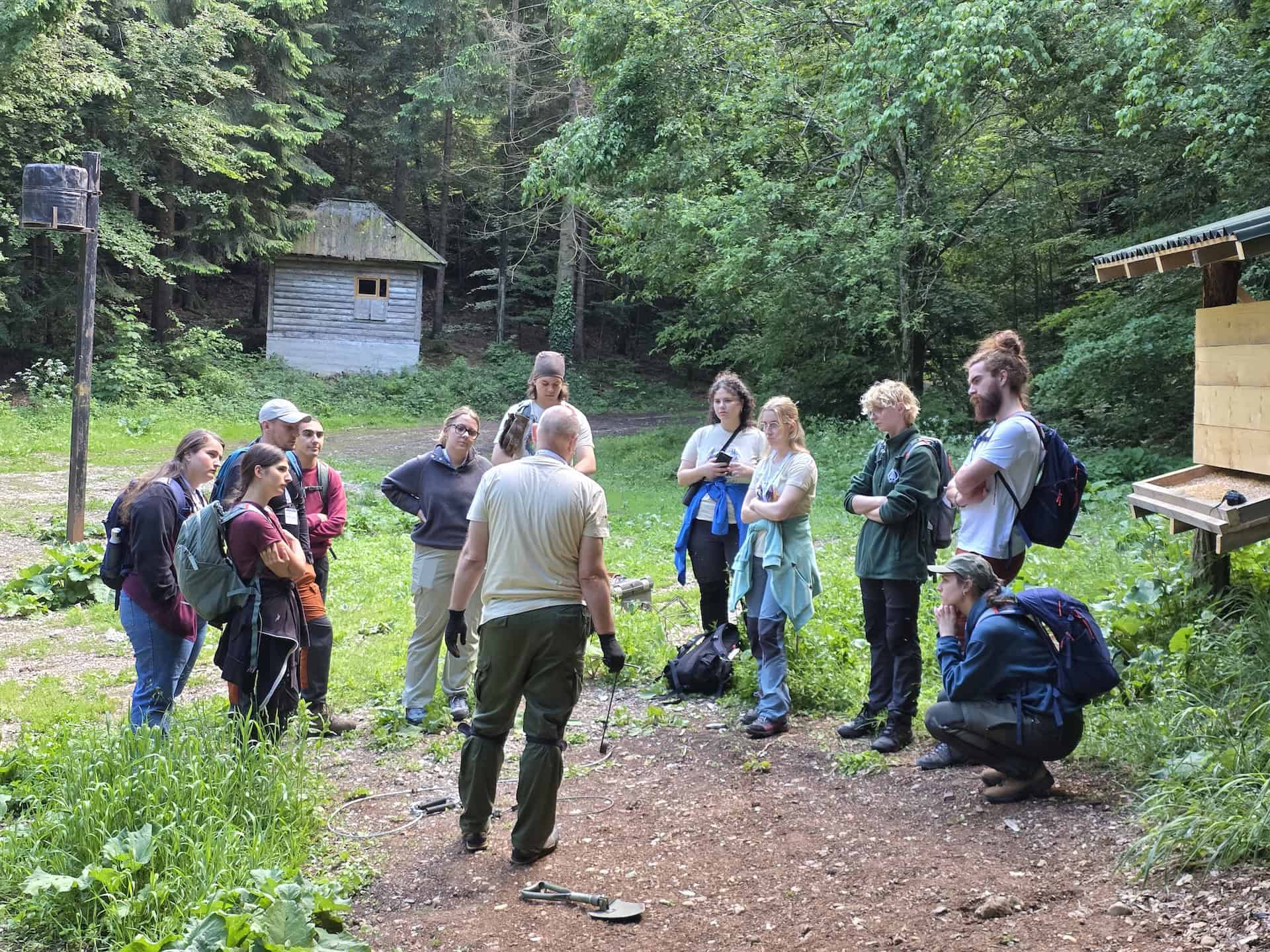
Within the 4PETHABECO project, school workshops introduced students to a variety of wildlife monitoring techniques under expert guidance, including camera trapping, telemetry, acoustic stimulation, track and sign surveys, the collection of biological evidence and the interpretation of monitoring data. These experiences demonstrate that citizen science is not limited to collecting observations; it can also help students understand how scientific information is generated, validated and applied to biodiversity conservation.
Educators should progressively adapt activities to students’ knowledge and confidence. Beginning with simple observation and identification tasks allows learners to develop essential field skills before progressing to more structured monitoring activities and data interpretation. This gradual approach encourages active participation while fostering curiosity, critical thinking and a deeper understanding of ecological research.
Using iNaturalist or Project Tools
Digital platforms are valuable tools for involving citizens in biodiversity monitoring. They allow observations to be recorded in a standardised way, shared with other users and experts, and combined with additional records to improve knowledge of species distribution and conservation.
Within the 4PETHABECO project, educators and students can contribute to the iNaturalist project “Join Wild Tracks: Adriatic-Ionian Carnivores”, created to collect observations of brown bear, grey wolf, Eurasian lynx and golden jackal across the Adriatic–Ionian region. The project gives students an opportunity to participate in an authentic citizen science initiative while learning how biodiversity data are collected, documented, validated and contextualised.
When using digital citizen science tools, educators should encourage students to record observations carefully by providing photographs whenever possible, selecting the most accurate location available and including relevant notes. Students should also understand that not every observation requires direct contact with an animal. Tracks, scats, feeding signs, camera-trap images and other indirect evidence can provide valuable information when recorded appropriately.
Citizen science platforms also demonstrate that scientific research is a collaborative process. Observations submitted by participants can be reviewed, discussed and identified by a community of users and experts, allowing students to experience how scientific knowledge is refined through collaboration and evidence.
Educators can use project tools alongside classroom activities to connect field observations with scientific research while developing students’ digital skills, environmental awareness and understanding of biodiversity monitoring. In this way, students can experience active participation in the project while seeing how their own observations contribute to the advancement of broader regional knowledge.
Recognising Tracks, Signs and Observations
Observing large carnivores in the wild is uncommon because these animals are generally elusive and often avoid human presence. For this reason, wildlife monitoring frequently relies on indirect evidence rather than direct sightings. Learning to recognise these signs helps students understand how researchers study wildlife while developing careful observation skills.
Depending on the local environment and the educational activity, students may learn to identify footprints and tracks, scats, hair, scratch marks, feeding signs, dens or camera-trap images. They should also understand that different species leave different types of evidence and that environmental conditions, such as weather or soil type, can affect how easily signs can be recognised.
Activities should emphasise careful observation rather than immediate certainty. Students should be encouraged to document what they find with photographs, notes and location information instead of attempting to identify every sign independently. Uncertain observations can still be valuable when clearly recorded and may later be examined by teachers, researchers or experienced volunteers.
Educators should also explain that some observations require particular care. Biological samples should not be collected unless this is part of an authorised activity conducted under expert supervision. Respect for wildlife, habitats and legal requirements should always guide field activities.
Learning to recognise tracks and other field signs encourages students to observe nature more carefully and appreciate that scientific knowledge is often built from small pieces of evidence collected over time.
Recording High-Quality Data
Collecting an observation is only the first step in citizen science. The value of a record depends largely on how accurately it is documented. Teaching students to record observations carefully helps them understand why reliable data are essential for scientific research and biodiversity monitoring.
When recording an observation of a large or mesocarnivore, students should provide as much relevant information as possible. Depending on the platform and activity, this may include the date and time, location, photographs, species identification, type of evidence observed and a short description of the circumstances. Photographs should clearly show relevant features and, where possible, include a scale reference and images from different angles of tracks, marks or other evidence.
Students should also learn to distinguish between what they observe and what they assume. For example, a photograph of an unidentified footprint should be recorded as an observation of a footprint rather than automatically identified as belonging to a wolf, bear, lynx or jackal. When identification is uncertain, students should indicate this rather than making an unsupported identification. Uncertain but well-documented observations can still be useful and may be assessed later by teachers, researchers or other experienced participants.
Location information is particularly important for biodiversity monitoring because observations can contribute to understanding species distribution and habitat use. Educators should nevertheless explain that location data must always be recorded and shared responsibly, particularly when observations concern sensitive species or locations.
A useful classroom approach is to compare examples of well-documented and poorly documented observations. Students can identify which information is missing and discuss how this affects the usefulness of each record. This activity helps them understand that scientific data need to be sufficiently accurate, complete and traceable to support meaningful interpretation.
Encouraging careful documentation also reinforces a broader scientific principle: quality is more important than quantity. A smaller number of reliable observations can be more useful for research than a large number of incomplete or inaccurate records.
Safety, Privacy and Data Validation
Citizen science activities involving wildlife should always prioritise the safety of students, teachers and animals. Educators should establish clear rules before field activities and ensure that students understand that observing wildlife does not require approaching, following or disturbing animals. Large carnivores are generally elusive, but encounters can occur, particularly in areas where animals are present or where food may attract them.
Students should remain with the group, follow the instructions of the teacher or activity leader, and respect access restrictions and local regulations. Field activities should be adapted to the local environment, weather conditions and participants’ level of experience.
Responsible citizen science also involves protecting privacy and sensitive information. Photographs may unintentionally include people, private property, vehicles or other identifiable information. Educators should therefore encourage students to check images before sharing them and to follow the privacy rules of the platform being used.
The location of observations may also require particular care. Information about dens, breeding sites or other sensitive wildlife locations can potentially expose animals to disturbance. Students should understand that accurate scientific data do not always need to be publicly displayed at their highest spatial resolution. When appropriate, sensitive locations should be handled according to the procedures established by the platform, project or responsible authorities.
Data validation is another important part of responsible citizen science. An observation submitted to a digital platform is not necessarily a confirmed scientific record. Other users, specialists or researchers may review the photographs, descriptions and location information and suggest or confirm an identification.
Educators can use this process to introduce students to scientific uncertainty. An observation may initially have an uncertain identification and become more reliable as additional evidence or expert assessment becomes available. This provides a practical example of how scientific information is checked and progressively improved.
Using the Results in Class
Citizen science does not end when observations are submitted. Using the resulting data in the classroom allows students to understand how individual records can be combined, analysed and interpreted to answer questions about biodiversity and wildlife conservation.
Depending on the amount and type of data available, educators can introduce students to simple forms of data analysis. For example, students can map observations, compare records from different locations or periods, identify patterns in species occurrence and discuss possible explanations for differences. Camera-trap images and other records can also be used to explore questions about animal activity, habitat use and seasonal variation.
The aim should not be to produce complex statistical analyses. Simple questions can provide valuable learning opportunities. Students might ask: Where were most observations recorded? Which species were observed? Were some types of evidence more frequent than others? Did observations vary between seasons or habitats? What additional information would be needed to answer these questions more confidently?
Educators should also encourage students to distinguish between observation and interpretation. A concentration of records in one area does not necessarily mean that animals are more abundant there. It may reflect differences in habitat, accessibility, sampling effort or the number of people collecting observations. Discussing these limitations helps students understand why scientific data need to be interpreted within their context.
The results can be used in different subjects and learning activities. Students can create maps, graphs or short reports, present findings to their classmates, compare their observations with published information or discuss how the data could support conservation decisions. They can also reflect on their own contribution and consider how citizen-generated observations complement information collected through professional monitoring programmes.
Within the 4PETHABECO context, the Join Wild Tracks: Adriatic-Ionian Carnivores project offers an opportunity to connect local observations with a broader regional perspective. Students can explore how records collected by different participants contribute to a shared picture of large and mesocarnivore presence across the Adriatic–Ionian region. This local-to-regional perspective can then be extended to a wider scale, helping students understand how biodiversity data collected in individual territories can contribute to broader scientific knowledge.
This local-to-global dimension can be particularly valuable for students. An observation made in their own school area, village or local landscape may initially appear to have only local significance, but when combined with observations collected by other participants it can contribute to a much broader understanding of species distributions. Where data are shared through appropriate biodiversity data infrastructures, such as the Global Biodiversity Information Facility (GBIF), observations can become accessible alongside records from many other sources and countries. This helps students understand that a data point collected locally can become part of a wider body of biodiversity knowledge used for research, monitoring and conservation.
Using results in class therefore completes the citizen science cycle: students observe, record, contribute, examine and communicate information. It also makes visible the journey of a biodiversity record from the local territory to wider scientific databases and knowledge networks. This approach transforms data collection into an active learning process and helps students understand both their role in generating knowledge about biodiversity and the potential value of their observations beyond their immediate surroundings.