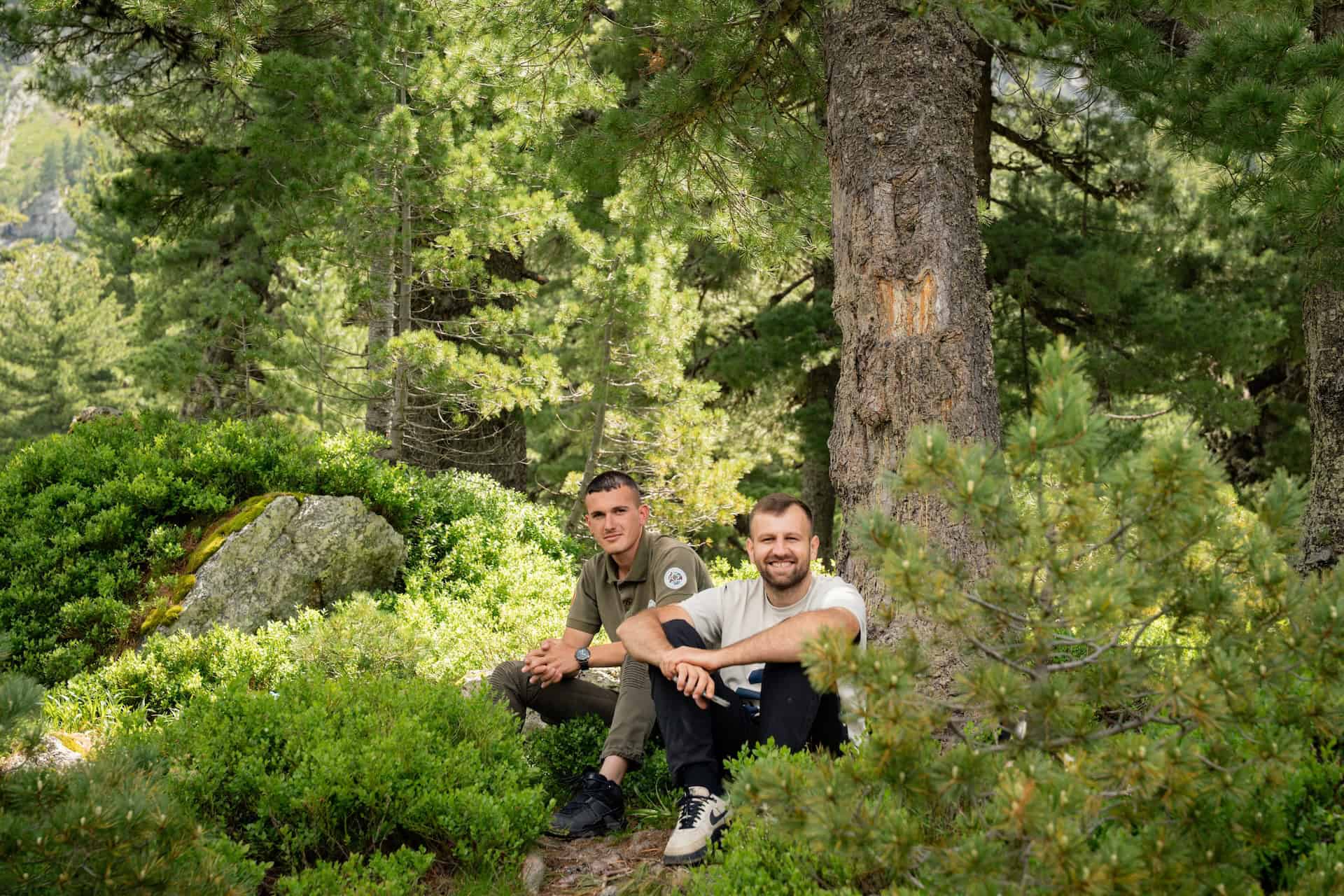
Citizen scientists and other members of the public can make an important contribution to monitoring large carnivores and golden jackals, particularly across the diverse and often fragmented landscapes of the Adriatic-Ionian Region. Local residents, hunters, foresters, protected-area staff, rangers, hikers, farmers, photographers, nature organisations, and other trained observers may provide valuable information on species occurrence, distribution, movements, mortality, reproduction, and changes in areas where systematic monitoring is difficult or resources are limited.
Effective collaboration should be based on clear roles, mutual respect, transparent communication, and recognition of the contribution of all participants. Citizen scientists should be provided with clear guidance on what types of observations are useful, how and where records should be submitted, and what information should accompany a report. At the same time, researchers and conservation organisations should provide appropriate feedback and explain how submitted observations contribute to monitoring and conservation.
Citizen-generated records should be assessed using the same general principles of data quality and validation applied to other monitoring information. Photographs, videos, tracks, signs, carcasses, direct observations, and other evidence can provide valuable information, but their reliability may vary. Records should therefore be reviewed by appropriately trained personnel before being used in scientific analyses, official monitoring assessments, or management decisions. Uncertain observations should be retained where useful but clearly identified as unverified.
Participation should never encourage people to approach, follow, chase, feed, bait, call, or otherwise disturb wild animals in order to obtain observations or photographs. Citizen scientists should be encouraged to observe animals from a safe and appropriate distance and to respect protected areas, private property, seasonal restrictions, and other applicable regulations. Particular care is required around dens, breeding sites, resting locations, carcasses, and other sensitive areas.
Personal information and sensitive wildlife locations obtained through citizen-science activities should be handled responsibly. Contributors should be informed about how their observations and photographs may be stored, used, shared, or published, particularly when records contain precise locations or identifiable people.
Long-term participation should be supported through training, accessible reporting mechanisms, feedback, and appropriate recognition of contributions. Citizen science should be regarded not simply as a source of additional observations, but as a collaborative approach that can strengthen local knowledge, public engagement, trust in monitoring programmes, and conservation of large carnivores and golden jackals.
Roles and Responsibilities
Citizen scientists can provide valuable contributions to the monitoring of large carnivores and golden jackals, particularly in areas where systematic monitoring is limited by geographical extent, accessibility, available resources, or personnel. Local residents, hunters, foresters, protected-area staff, rangers, farmers, hikers, photographers, nature organisations, and other interested members of the public may contribute observations and other relevant information.
The roles of researchers and citizen scientists should be clearly defined from the beginning of a monitoring activity. Researchers and conservation organisations should provide clear instructions on the type of information required, appropriate methods of observation and reporting, and the expected use of submitted data. Citizen scientists should follow agreed procedures and should not undertake activities that could disturb animals or compromise the reliability of monitoring.
Citizen science should complement, rather than replace, systematic scientific monitoring. Citizen-generated observations may provide particularly useful information on species distribution, range expansion, unusual occurrences, mortality, reproductive evidence, and changes in areas that are not regularly covered by professional monitoring teams. However, the limitations and potential biases of opportunistic observations should be recognised when such information is interpreted.
Researchers should treat citizen scientists as contributors to the monitoring process and maintain respectful and transparent communication. Contributors should be informed about how their observations will be used and, where appropriate, about the results or conservation actions supported by their contributions.
Reporting, Data Quality and Validation
Citizen scientists should have access to simple and clearly explained procedures for submitting observations. Reporting systems may include online platforms, mobile applications, dedicated forms, communication with researchers or conservation organisations, or other locally appropriate mechanisms.
Reports should include sufficient information to allow the observation to be assessed. Where possible, this should include the species, date and approximate time, location, type of evidence, circumstances of the observation, and information about the observer. Photographs or videos should be provided where available and appropriate. Contributors should be encouraged to report observations as accurately as possible and to distinguish direct observations from information received from other people.
Citizen-generated records should be assessed according to defined data-quality and validation procedures. The fact that an observation was submitted by a citizen scientist should not automatically determine whether it is accepted or rejected. Instead, the reliability of the evidence should be evaluated using the same general principles applied to other monitoring records.
Photographs, videos, tracks, carcasses, genetic material, field signs, and direct observations may have different levels of evidential value. Where appropriate, experienced researchers or trained personnel should review submitted evidence and assign an appropriate validation status. Uncertain or unverified records may still be useful for further investigation, but they should be clearly distinguished from confirmed records in databases, analyses, and reporting.
Citizen-science data may have spatial or temporal biases because observations are more likely to be submitted from areas that are easily accessible, frequently visited, or of particular interest to the public. These potential biases should be considered when using citizen-generated data for distribution assessments or other analyses.
Training, Safety and Ethical Wildlife Observation
Citizen scientists should receive appropriate guidance before participating in activities that involve observations or collection of monitoring evidence. Training does not need to be highly technical but should provide participants with sufficient information to recognise the target species, document observations correctly, use reporting tools, and understand basic safety and ethical principles.
Participation should never encourage people to approach, follow, chase, call, feed, bait, or otherwise disturb large carnivores or golden jackals in order to obtain photographs, video recordings, or other evidence. Animals should be observed from a safe and appropriate distance, and their normal behaviour should not be intentionally altered.
Particular caution is required around dens, breeding sites, resting locations, carcasses, feeding sites, or other areas where animals may be sensitive to disturbance. Citizen scientists should be encouraged to report the observation without approaching such locations or attempting to determine their exact position.
Participants should also be informed about appropriate behaviour in protected areas, private land, hunting areas, and other locations where specific access or safety requirements apply. They should not enter restricted areas or private property without permission. Activities involving potentially dangerous encounters with large carnivores should be avoided, and participants should follow relevant local safety guidance.
Where citizen scientists are asked to collect physical samples or other material, this should only be undertaken when appropriate instructions, permissions, and safety procedures are available. Participants should not attempt to collect material that could expose them to unnecessary risks or require direct interaction with animals or carcasses.
Recognition, Communication and Long-term Engagement
Long-term citizen-science programmes should aim to establish a relationship based on trust, transparency, and mutual benefit. Contributors should receive appropriate recognition for their efforts and should be informed, where feasible, about how their observations contribute to monitoring, research, management, or conservation.
Recognition may include acknowledgement in monitoring reports, project websites, presentations, publications, or other appropriate outputs. The form of recognition should reflect the nature and extent of the contribution. Where citizen scientists make substantial contributions to data collection, interpretation, project development, or other research activities, their contribution should be discussed explicitly within the relevant collaboration and publication framework.
Researchers and conservation organisations should provide feedback on submitted observations whenever feasible. Even when an observation cannot be confirmed, explaining why evidence was considered uncertain can help participants improve their future reporting and strengthen the overall quality of the monitoring programme.
Communication with citizen scientists should avoid creating unrealistic expectations about the certainty or immediate conservation value of individual observations. Results should be communicated accurately and in an accessible manner, while sensitive information about animal locations, vulnerable individuals, or other conservation concerns should not be disclosed unnecessarily.
Citizen-science programmes should also encourage continued learning and participation through appropriate training, guidance, feedback, and opportunities for engagement. Building a network of informed local observers can provide long-term benefits for early detection of changes in species distribution, identification of emerging human–wildlife conflicts, and broader public understanding of large carnivore and golden jackal conservation.
The overall principle should be that citizen science strengthens professional monitoring through additional observations and local knowledge while maintaining scientific reliability, animal welfare, participant safety, privacy, and responsible treatment of sensitive information.